Hey everyone!
I had a fantastic opportunity recently to do a Pop-Up Swap with fellow NineStar Press author Andrew J. Peters. You may remember I did an Author Interview with him earlier this year with his release Irresistible. This time, we exchanged our Urban Fantasy books, read them, and then did interviews with each other about those books.
So, while Andy had my Magic or Die, I had his Werecat Trilogy.
I can tell you the read was fantastic, but before we go there, here’s a little introduction:
Biography:

Andrew J. Peters has been writing fiction since his elementary school principal let him read excerpts from his mystery novel over the PA system during lunch period, an early brush with notoriety, which quite possibly may have been the height of his literary celebrity. Since then, he has studied to be a veterinarian, worked as a social worker for LGBTQ youth, and settled into university administration, while keeping late hours at his home computer writing stories. He is the author of eight books, including the award-winning The City of Seven Gods (2017 Best Horror/Fantasy Novel at the Silver Falchion awards) and the popular Werecat series (2016 Romance Reviews Readers’ Choice Awards finalist). Andrew lives in New York City with his husband Genaro and their cat Chloë. When he’s not writing, he enjoys traveling, Broadway shows, movies, and thinking up ways to subvert heteronormative narratives.
Socials:
Now, let me also share with you that from my past interview with Andrew, he’s a really smart guy, so I hope I can dig up some really tough questions for him.
Here’s Andrew’s Book:

Blurb:
Twenty-two-year-old Jacks is plunged into the hidden world of feline shifters on a lost weekend in Montréal. He emerges with fantastical abilities, but he’s also faced with a possessive maker and a wild animal nature he must control if he wants to keep the one man who accepts him for who he is. He’s caught between two worlds and soon fighting for survival as a suspect in the gory murders of two men and an enemy of members of his kind who want to destroy man for the atrocities of the past.
The Trilogy includes The Rearing (Book One), The Glaring (Book Two), and The Fugitive (Book Three).
Also in the Werecat series: The Sim Ru Prophecy (Book Four).
And of course, the links where it can all be found:
Goodreads | Amazon | Kobo (The Rearing)
JP: I’d like to thank you, Andy, for suggesting this Pop-Up Swap. It’s really been a lot of fun, and it made me think of different things I could ask you while reading your trilogy. I have questions! But before we get to the book, I’d like to know a little bit more about you! Tell us, where do you hail from, how did you meet Genaro (your husband), and who is Chloë’s (the cat) favorite?
AP: Thank you for taking part in the Swap!
I grew up in Amherst, New York, which is a northern suburb of Buffalo. So shout-out to the native Buffalonians visiting your blog. We’re kind of a diaspora. Buffalo was an economically-depressed city for pretty much the last half of the 20th century so a lot of people of my generation and older took off for better opportunities. The city has made a bit of a comeback of late, which I’m really happy about.
But I was one of the people who took off, starting with going away to college and then going to graduate school just outside of New York City where I eventually ended up. There just weren’t decent-paying jobs, and another reason I left was back then Buffalo was a pretty socially-conservative, blue-collar, Buffalo Bills tailgating, hard-drinking paradise for some, but not for young gay me.
I’ll tell you a sad story. This was back in the early 90s. The LGBT community had just started having Pride parades, and a big debate was whether or not everyone should wear bags over their heads because they weren’t ready to be that out. Things have changed for the better on that score as well, but when you could almost count every out LGBT person on your two hands, I was like, there’s got to be a better place for me.
So yeah, you and I are both old(er) married guys. And I’m old enough that when I say Genaro and I met the old-fashioned way, I mean at a bar, not through some dating app. My husband loves to tell the story.
We were both out bar-hopping with separate friends, and we definitely noticed each other. But it was really early in the evening and maybe neither of us had had enough to drink to have the guts to introduce ourselves.
Later in the night, we both ended up at another bar again; at which point Genaro, having tossed back a few cocktails, walked straight up to me while I was exchanging phone numbers with some guy and was pretty much like: What’s going on here? You don’t need that phone number, Sweetie. I saw him first. He was really cute and feisty and what else could I do but spend the rest of the night getting to know him? And he called me at like four o’clock in the morning to make sure I got home okay, so that scored major points. We scheduled a real date a few days later, and a year and a half later, we were walking down the aisle.
Who is Chloë’s favorite? That’s like a Newlywed Game question, but I’m pretty confident the two of us would match answers. When we have house guests, Chloë likes to sit on top of me and gaze smugly at everyone, so I think I’m Daddy #1.
JP: I know from our past interview we both like to travel. What’s been your favorite place to visit and why? Did any of your travel destinations end up being locations in the Werecat Trilogy?
AP: We fell in love with Mykonos, Greece back in 2004. Besides being beautiful, it just felt laid back and it’s so cool meeting gay people who flock there from all over the world. When we came up to our tenth anniversary, we decided to go back and a bunch of our friends wanted to go too, so it became this anniversary trip with friends. We went back with a big group for our 15th, and we’re planning to go for our 20th in 2021.

So funny you should ask about travel and the Werecat locales. That story certainly started as write-what-you-know. I also adore Montréal and thought it was a neglected setting for a gothic horror/paranormal story with its 18th-century architecture, a touch of seediness, the nightlife, and its huge, wooded Mont Royal park. Then the other locales in the first book are upstate New York, which I know, and New York City, where I’ve lived for 20+ years.
But boy did I wish I’d been to all the places Jacks ends up at as the series expanded. I’ve been to the Caribbean but not Barbados or Trinidad. I had to do so much research to get things right. I spent a ton of time using Google Earth literally charting out Jacks going from here to there and researching yacht clubs and the bank where the action takes place.
Then I can tell you, the final installment has Jacks running from Caracas, Venezuela, to little towns in the Amazon, Columbia, Samoa, and the Yucatan peninsula in Mexico. I’ve never been to any of those places so it was research galore.
JP: Alright, the Trilogy…Here’s the biggest question I wanted to ask you about the three installments (I know there’s a fourth). The stories are all quick reads, more like novellas, and yet, there were times when I was reading it that I was saying to myself…”No, tell me more! I want to know why! More!” I yelled at the book a few times. You pulled me into the story but then kept it short. Was that on purpose?
AP: Sorry about that. It was nothing personal, Jeff. 😊 But yes, I definitely set out to write fast-paced reads, keeping with paranormal thriller conventions to be really thrifty with character development in favor of propelling the hero forward with action sequences.
The pace slows down a hair as the story rolls on. There’s more plot and character complexity in The Fugitive, and the last book The Sim Ru Prophecy is novel-length.
JP: There are some fantastic scene descriptions scattered throughout the stories. I’d say you nailed feline characteristics, and the concept of house cats as “the strays” who are more like a bunch of tattle-tales or should I say tattle-tails, with telepathic abilities was genius. It completely made sense and gave cats a whole new spin. I think I distrust them more now than before I read your book. Where did the inspiration come from for all your feline behavior, and cats acting as go-betweens or familiars to werecats?
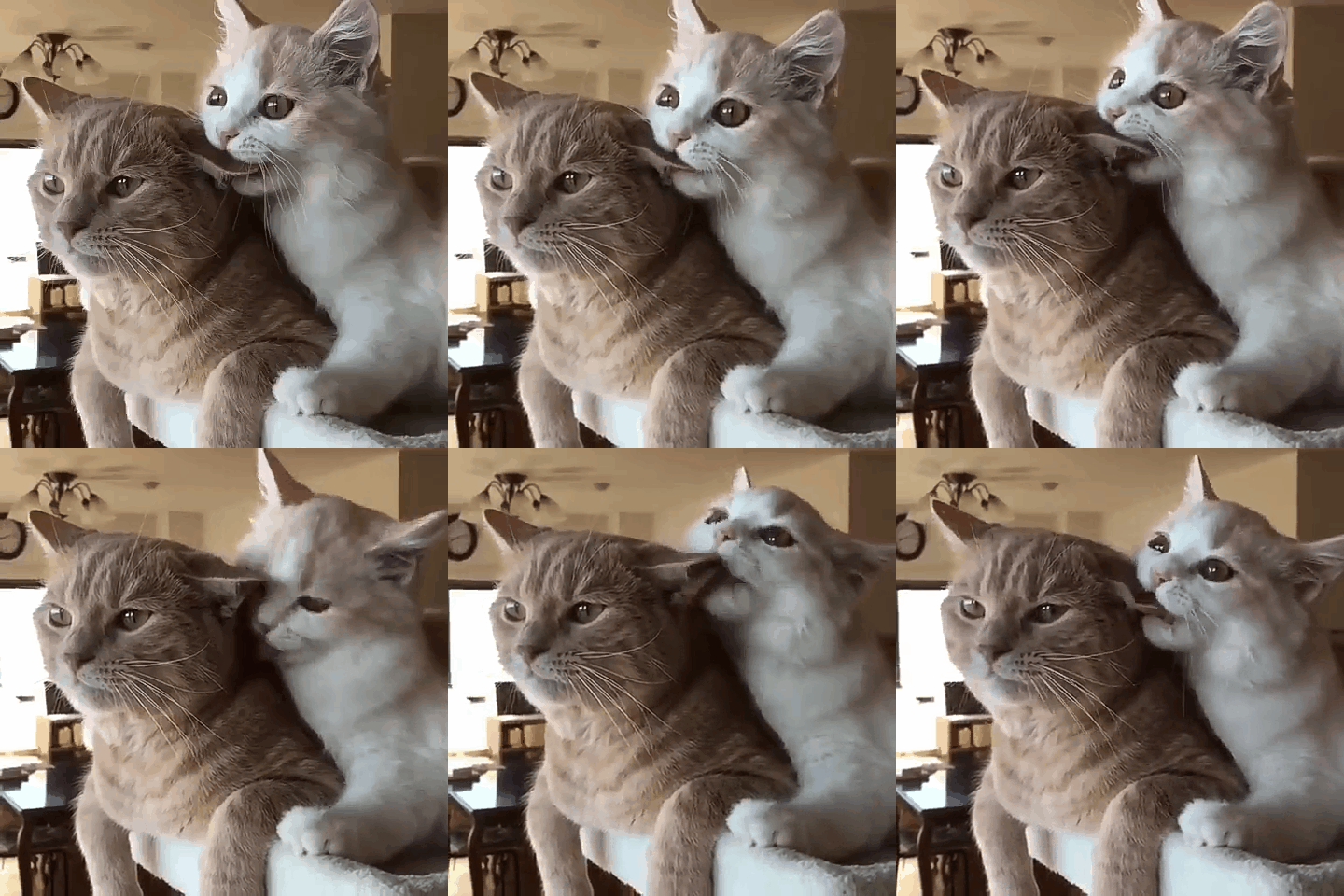
AP: I’ve lived with domestic cats since my parents let me pick out a kitten to take home from the SPCA when I was in elementary school. She was all black, and I named her Pickles, which comes from a children’s book series Pickles the Fire Cat about a cat who gets adopted by a firehouse.
Anyway, I love how enigmatic cats are. I mean if you’ve ever seen a cat staring at a blank wall in the dead of night, seeing something you can’t, it’s easy to believe they have some kind of telepathy or ability to see ghosts and spirits, or in the case of my imagination, they sense a werecat in the vicinity.
I’m also inspired by their paradoxical behavior. A lot of people have probably had the experience of observing their cat become enamored of one person you have over to the house but then being totally standoffish with others. They know something we don’t because it’s fairly unpredictable. Chloë, for instance, loves some of our friends who are big guys, you’d think threatening-looking guys to her, and she’ll have nothing to do with some of our less intimidating friends who try for hours to pet her.
So that expression: a cat keeps its own counsel, was a major ingredient in my portrayal of the strays. They form a bond with certain werecats and help them out by keeping lookout or spying and bringing them information about their enemies, and part of that is feline social behavior—bigger cats dominating smaller ones—but another part is the strays choosing who they’re going to be loyal to, which is that curious, instinctual aspect to cats that are based on senses humans don’t possess.
JP: The brother and sister characters were quite interesting. Maarten and Annika didn’t end up being quite what I had originally anticipated. Maarten seemed like he was the one in control, yet it was actually Annika who was the protector and watcher, ensuring her brother kept his heathen lifestyle down to a dull roar (All the puns intended there). I sensed an aggravated sibling rivalry. How much backstory did you create for these two that never ended up in the novel?
AP: I enjoyed developing those characters, and yeah, their backstory pretty much only comes through via some dialogue between Jacks and Annika. She and Maarten grew up being mixed race and raised by their mother’s white family in late Apartheid-era South Africa. That was an appealing situation and setting for a werecat origin side story to me.
So one of the backstory elements I thought about a lot with Maarten and Annika has to do with how they managed racial oppression. Maarten became more rebellious and wanted to reject any association with his white family even though he’s half-white, which creates some buried guilt. Annika coped by becoming the peacekeeper in the family, avoiding conflict, probably suppressing her feelings about being “other” both among whites and blacks while meanwhile white police squads were killing black people rioting in the townships.
There’s a parallel in how they handled their lives after being “reared” as shapeshifters. Maarten becomes fixed in his disdain for humankind which will never accept him, and he’s trying to insulate himself from the world, on an endless pleasure cruise with other disaffected werecats. It’s not an entirely successful way to manage his feelings, thus he drinks too much, gets high on catnip too much, and develops an inflated sense of self-importance.
Annika chooses to follow him and protect him, and what might not come through on the page as much, is that’s also a choice based on fear and alienation. Because she doesn’t know where else she fits in the world, and I wanted to portray that as a challenge of being both mixed race and mixed species.
JP: All throughout the novel, there’s a general sense of foreboding doom. I find it creates a dark element. Think of the TV Show Supernatural. The sets they used were all dilapidated houses, hotels, parks, etc. There’s an underlying element of dankness or rot. It adds to the dystopian/apocalyptic feel. I completely got those creepy vibes reading The Werecat Trilogy. Was that intentional? Or was that simply my interpretation? There are a few scenes in the book while on Maarten’s Pride (the yacht) where they’re cruising through the Caribbean and the sun-filled days of self-indulgent behaviour is made all that more of a glaring contrast to the ultimate reality of a possible upcoming war against all of humanity. Again, done on purpose? Or simply a reader’s interpretation?
AP: I definitely chose to portray werecat living as dark. That’s the only way I could imagine it. Well, I guess I should say, that’s because I chose an otherwise realistic setting for the story.
I took my inspiration points from feline mythology around the world. There’s a rich indigenous tradition of feline god/goddess worship and beliefs in feline souls or spirits as well as feline polymorphism and dual feline/human creatures. Then European imperialism happened, and indigenous genocides happened, and Christian missionaries happened, nearly exterminating those native cultures. I imagined werecats existed within those indigenous communities as jaguar shamans and men and women with cougar souls, so they would have been nearly driven to extinction as well. So you see how I envisioned an inevitable sense of tragedy and alienation.
The other factor is my hope was to write a story that was satisfyingly suspenseful and with the stakes for Jacks growing bigger and bigger. So he starts out knowing nothing about what it means to be a werecat, but I wanted to provide some foreshadowing of the danger he’s headed into. I’m glad that mood came across for you.
JP: Have you seen the movie Cat People (Nastassja Kinski, Malcolm McDowell, and John Heard, 1982)? This was one of my favorite movies growing up as a teenager. And it was a hugely different take on the Urban Fantasy/Myth behind Shifters/Skinwalkers/ Werecreatures. The Werecat Trilogy made me think of this movie many times throughout the book. Popular culture has idolized the werewolf for a really long time, just thinking about the 1941 movie The Wolf Man starring Lon Chaney. What made you write a story about werecats instead of the usual werewolf go-to Urban Fantasy/Horror creature?

AP: I saw Cat People when I was a teenager as well, probably on HBO, and I re-watched parts of it while writing the series. This may be disappointing, but I wouldn’t rank it as one of my favorite films. I’ve written about this subject on my blog in pondering why werecat portrayals haven’t been as successful as werewolf portrayals, at least in my view.
I think it has something to do with feline characteristics being associated with femininity, and this is more a criticism of the male creators of Cat People and other werecat “takes.” But it’s less interesting to me when the point of view is a heterosexual male gaze, titillated by taboo female eroticism and declaring heterosexuality as savior to “degeneracy.” I use the term “gaze” in the way Toni Morrison did in talking about black stories written by white authors versus black stories written by black authors. I think that’s a really powerful concept that can apply to portrayals of women, ethnic minorities, gay people and anyone who is considered “other.”
But a more straight-forward answer: I’ve always loved cats and I wanted to uplift werecat mythology, which doesn’t get nearly the same attention as werewolves. I mean, there are a lot of werecat stories in the m/m romance world, but my hope was to take werecats beyond that niche and show their story from a gay male gaze rather than a female gaze.
JP: There’s a fourth book in this saga, The Sim Ru Prophecy. I have not read it yet, but it is on my list. Give us a bit of a spoiler, does this end the story with a neat tidy bow? Or is there room to continue the story and add onto your Werecat universe? Is that something you’d entertain – expanding or continuing the story or is it at its completion point?
AP: I’m not great at tying up anything I write in a tidy bow at the end. However, a lot gets wrapped up as Jacks confronts the only way the stop the war between werecats and humankind.
I’d say I’m sixty percent sure I won’t continue the story. It pulls at me sometimes to write what could happen next or to try out another story from the Werecat universe. You’ll see there are directions in which that could go, though Jacks’ overarching mission gets completed.
The series has done well by small press standards, but I guess another reason I’m half-hearted is that’s small press standards. The first book is approaching 20,000 downloads, but things have tapered off. If the series was still making great sales with the final book being out for two years now, I’d probably feel differently. But hey, you never know.
JP: Shifter lore often comes with some expectations from readers. I find that shifters, in general, seem to be very sexual creatures, and I don’t really think that Jacks, Benoit, and Maarten were far from that expectation. Yet, I didn’t find the story had the nitty-gritty sexy fun times that often show up in shifter stories. It was certainly hinted at – and the cuddle clowder of all-male werecats on the yacht was extremely sexy. Which do you think is sexier – leading the reader through the intimate details, or letting the reader create the scene themselves? Did you get any negative/positive reviews for how sex was addressed in these stories?
AP: I did get some negative and a few, somewhat creepy positive reviews based on what’s probably the edgiest scene in the series. You might remember there’s a pretty graphic depiction of Benoit topping Jacks when they’re both in big cat form, and I went with the brutal, forced way that happens with big cats in the wild and included that peculiarity of feline penis anatomy—a barbed poker.
So that’s not exactly what you’re talking about, but it’s kind of emblematic of how I approached sex scenes in the story: realistic and pretty feral at times, and only on the page if it was in the service of plot or character or world-building. That early sex scene was to show Benoit’s dominance and to set the tone: this ain’t going to be no Thundercats story. When the characters shift to big cats, they’ve got all the majesty and the gruesomeness of wild jaguars and mountain lions.
Back to your question though, I think both implied intimacy and graphic intimacy can be sexy. Most of my writing stays on the R-rated or even PG-13 side, but I write gay erotica under a pen name and I read erotica from time to time.
In either case, what I appreciate is the execution and the tone. I tend to enjoy adventure-driven versus relationship-driven fantasy, but I don’t mind if the hero finds a boyfriend along the way; and if the tone is heartwarming, a first kiss can be sexy or the guys waking up the next morning putting their clothes back on is just fine for my imagination. With romance and erotica, what makes it sexy is the author really taking the reader there.
JP: Let’s talk about the concept of terrorism. The Glaring certainly feels like a vigilante group of angry shifters bent on ‘watching the world burn’ and then recreating their own version of reality. Given the current world political climate, and far swings to Conservative Right viewpoints, can you make, or was it intentional, a comparison of The Glaring to domestic/international terror groups?
AP: The story was written between 2012 and late 2015, so terrorism was on my mind in a different way actually. That was during the rise of ISIS and a really dicey period for Iraq’s rebuilt democracy, and the Paris terrorist attacks, the Boston Marathon bombing, and all the worries about disaffected young men becoming radicalized around the world. I think we’ve all had terrorism at least lurking in our subconscious since 9/11, but you’re right, the players and the targets have changed over the years.
I did have in mind some commonalities regarding how terrorism starts, and I guess you could say The Glaring is a fantasy interpretation of ISIS and Al-Qaeda. I don’t condone anything about those groups, though I am drawn to understanding the psychology behind them and the conditions in which terrorist groups emerge.
This actually comes out a lot more in The Sim Ru Prophecy when Jacks goes inside The Glaring. But my premise is The Glaring emerged from the desperation and fear werecats felt after having their territory and way of life taken away by humans, in the same way, Western Europeans and later Americans invaded the Middle East. Werecats have lived through the slaughter and subjugation of their tribes across the Americas, which is the main focus of the story, and also in Africa, India, and Southeast Asia. For some, violence and retaliation feels like the only answer.
JP: What’s next? Do you currently have a passion project? And if you could peg yourself into a particular Genre would you? I very much will always write Urban Fantasy/Paranormal. I might throw a host of other elements into those stories, but I gravitate towards the darkness. Where’s your center? What is ‘home’ for you?
AP: Well, my answer to your first question provides a context for the second. I have an anthology Smashed and Mashed: Seven Gayly Subverted Stories coming out from NineStar Press in November, and it’s myth and legend retellings from around the world. Also, I’m currently looking for a home for a gay YA buddy-comedy-adventure based on Telemachus’s story from The Odyssey. That one is zany and has a lot of adolescent humor and two of the main characters are Theseus and his hus-bull.

So my writing is all over the map. There was once a common thread with ancient world-inspired fantasy, and I guess there still is to the extent. But my first book with NineStar Irresistible which came out last year is a contemporary gay rom-com that I describe as a gay mash-up of There’s Something About Mary and My Big Fat Greek Wedding.
Yep, I’m all over the map.
I think it’s that my writing interests have shifted since I started out with a passion for epic, heroic fantasy. I guess creatively I needed to take a break from the deep research and deep themes those kinds of fantasy stories require. So I’m focusing these days on comedy as Andrew J. Peters and romance/erotica under that pen name I mentioned. I’ll be pretentious and call it my cotton candy and purple period; which still shows my stubborn resistance to settling down in one particular genre. Gay fiction? I guess there’s my umbrella or “home” as you said.
JP: And finally, I think it’s safe to say that both of our creative passions will always lie in telling stories, why is that? What do you think made you a storyteller? Were we just born that way, or are we made? What’s your writing goal? What would you like to see happen with your writing?
AP: I think storytellers are born. I have occasion to talk to other writers rather frequently, and I don’t think I’ve ever met an adult writer who didn’t say they’ve been writing all their lives. I’ve always loved to write and needed to write, pretty much from around the same time I started to read. I was already thinking about how I could write a children’s book or a story like The Phantom Tollbooth, and unfortunately, I did even back then. 😊
So that brings me to my other opinion about your question. I do think storytellers and writers are born that way, but I also think some are naturally talented and some have to work at the talent part, which can be learned. I definitely fall into the latter group. I’m incredibly jealous of writers who seem to have built-in ease, elegance, and lyricism to their prose. For me, I love writing, but I know I have to work hard on things like rhythmic flow, imagery, show versus tell, etc.
In terms of long term, mainly I just want to keep writing. I’m inspired by so many things, it’s often hard to settle down on one. I guess a goal for me would be to write another big adventure series, and my fingers are crossed that the Telemachus project catches air and takes flight. It has a lot of possibilities to spin-off from the first novel.
JP: Thank you so much for doing this with me. I had a great time, and it’s always fun to learn more about the authors behind their works. Until next time, cheers!
 J.P. Jackson
One thought on “Pop Up Swap: Andrew J. Peters”